Trailing at half-time and again with 20 minutes left, Clontarf scored the last 12 points to win 26–15 on the road, capped by a first-phase strike that showed what this group can do with clean ball.
THERE WAS A point in the second half when this looked like Lansdowne’s afternoon. They had just scored their second maul try to lead 15–14, they were winning the lineout battle, and they were getting into the Clontarf 22 far more often than the visitors were getting into theirs.
What followed was arguably the best 20 minutes of Clontarf’s U20’s season so far. Two more tries in the space of four minutes turned a one-point deficit into an 11-point lead, and the second of those, finished by fullback Finn Walsh, is worth looking at closely.
But first, how did they get there?
A half of small margins
Clontarf started brightly. Six minutes in, they won a lineout inside the Lansdowne 22, set a maul and hooker Juwon Adeoye was driven over. Alex Morley converted for 7–0.
That proved to be the only score Clontarf managed in the half. Lansdowne levelled on 20 minutes with a try built the same way, a lineout maul inside the 22, and edged ahead with a penalty just before the break. 7–10 at half-time.
The numbers from that first 40 told a story of a Clontarf side with plenty of ball and too little reward.
Set piece: one weapon, one worry
The set piece was the game in miniature.
Clontarf’s scrum was a weapon. They won 12 of their own put-ins that weren’t reset and lost three. Several of those resets were on their own ball, so it wasn’t entirely smooth, but when they needed a platform late on, the scrum gave them one.
The lineout was a different story. Clontarf won only seven of their 14 throws, a 50% return that would worry any coach. Lansdowne won nine of their 12.
And yet this is where the small margins come in. Two of Clontarf’s four tries came straight from lineouts they did win, both finished with a drive. When the throw went in clean, the pack was very hard to stop. The issue was getting it in clean often enough.
Making the visits count
If there is one statistic that explains the result, it is this one.
Lansdowne made 11 entries into the Clontarf 22 and came away with 15 points. Clontarf made only seven entries into the Lansdowne 22 and scored 26.
That’s roughly 3.7 points per visit for Clontarf against 1.4 for Lansdowne. Clontarf had more of the ball, about 59% of possession across the game, but less of the territory that matters. They made up for it by being clinical when they got there.
It’s a small sample from a single game, and a couple of bounces could tilt it. But it’s also a fair reflection of a side that finished its chances while the opposition didn’t. Lansdowne were also guilty of nine knock-ons, several in good positions.
The second-half turn
Clontarf retook the lead on 52 minutes after a long spell camped in the Lansdowne 22, lock Ryan Brazel crashing over at the end of a series of phases. Morley’s conversion made it 14–10.
Lansdowne hit back ten minutes later, again from a lineout maul, though the missed conversion left them only a point ahead at 14–15. With 18 minutes to play, the game could have gone either way.
Clontarf’s answer came from their pack. On 68 minutes they won a lineout, drove, and second row Cillian McCann was over a couple of phases later. 19–15.
Then came the try that put it out of reach.
Earning the scrum
Before the try itself, it’s worth rewinding 30 seconds, because the chance was earned the hard way.
It starts with a great Clontarf turnover at the breakdown, just on the half way line. With the ball back, inside centre Harley Fagan Harold quickly spots the space in behind the Lansdowne defence and puts boot to ball. Better still, he chases his own kick and gets close enough to be a real nuisance, forcing a poor pass from the Lansdowne receiver.
Alex Tilly is onto it in a flash. His tackle is hugely dominant, driving the carrier back around three metres and putting Lansdowne firmly on the back foot.
Lansdowne try to wrestle back the initiative with a strong carry, but they’re met by an even stronger force. Loosehead Loris Bacanou stops the carrier in his tracks, Cillian McCann chops low, and the Lansdowne man is bounced backwards. The ball goes forward.
That is what creates the perfect platform: a Clontarf scrum on the Lansdowne 22, 17 metres in from the right touchline.
For any young player reading this, it isn’t said often enough how much this part of the game matters. We’re about to look at a lovely one-phase strike play, straight off the training ground and out of Smithy’s playbook. But that opportunity only existed because of a minute of phenomenally powerful play without the ball.
The set-up
A scrum gives the attack one big advantage. Every defender is in a known position, and the back rows have to stay bound until the ball is out. For a few seconds, it’s backs against backs.
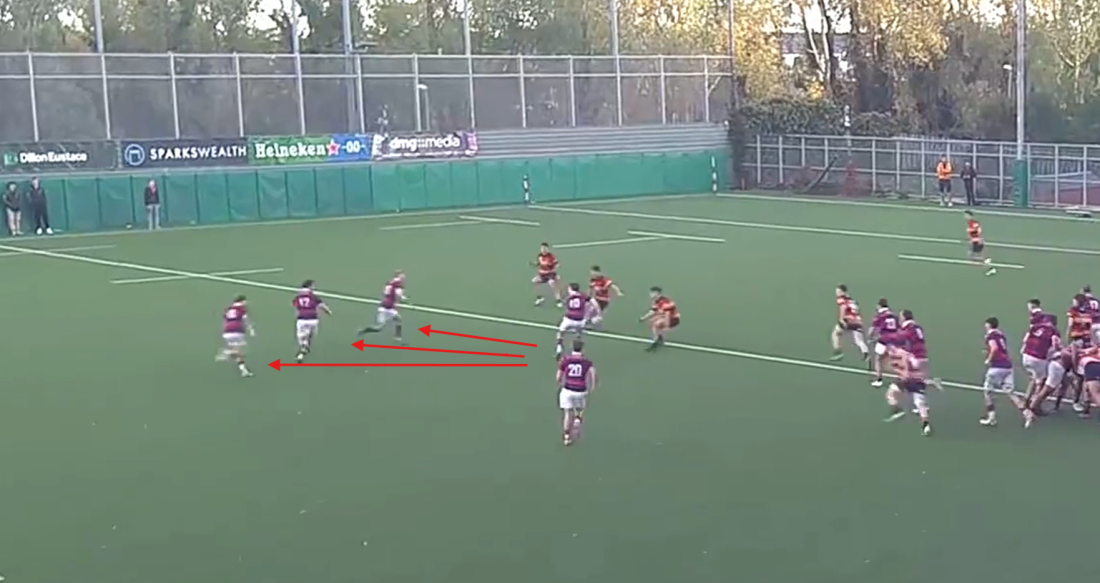
Look at where Walsh starts: back on the 10-metre line, a long way from the action. The question to ask of any strike move is where the extra attacker comes from. Here, the answer is the fullback, arriving from deep and at full speed.
The key pass
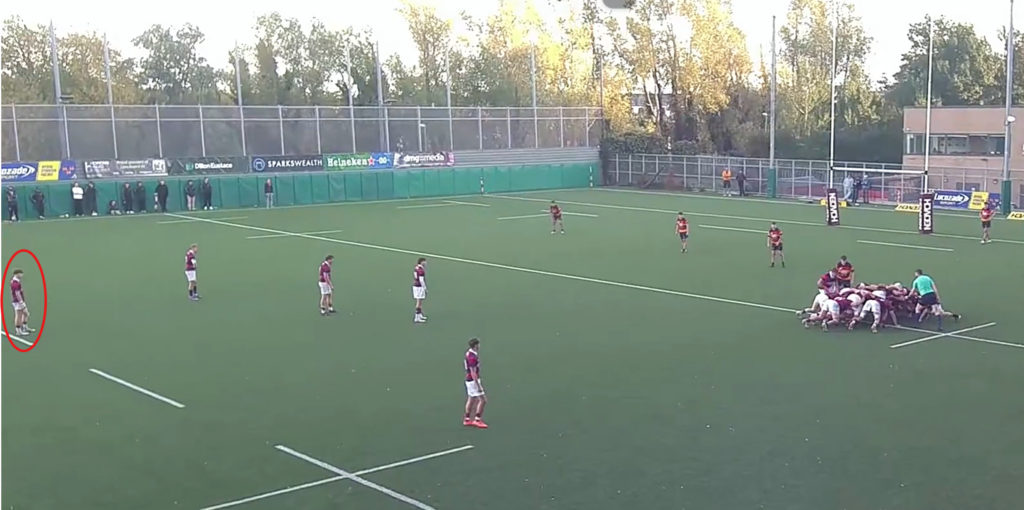
Aidan McDonnell, on at scrum-half since early in the second half, gets the ball away quickly. Morley takes it flat to the line.
This is the moment the move is built around, and the shape in front of Morley is perfect. Harley Fagan Harold at 12 runs out the back. Alex Tilly at 13 runs a hard, direct line. Walsh comes through on his own hard line behind them.
Let’s be honest: Morley has three genuine options here, and the Lansdowne defence has to respect all of them. The decoys do their job, and the ball goes behind them to Walsh.
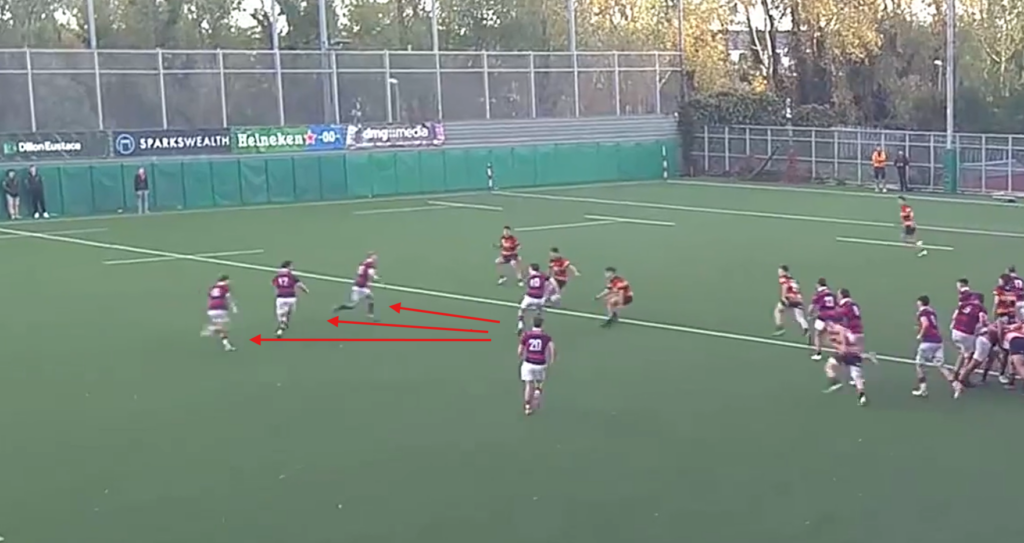
Could Lansdowne have done better? It’s easy to judge from the sideline, but when every runner is a real threat, a set defence is always going to be stretched. The timing of the move deserves the credit.
The finish
Walsh still has plenty of work to do. He steps the first defender, rides the second tackle and finishes with a powerful hand-off on the third before touching down. Wonderful.
From ball out of the scrum to the try took about eight seconds and two passes. No rucks, no recycling, no chance for the defence to reset.
Morley added the conversion, his third from four, to make it 26–15 with roughly eight minutes left.
The bench and the closing stages
It’s worth noting when the game turned. McDonnell’s introduction early in the second half coincided with Clontarf scoring three of their four tries, and he threw the scoring pass for the last of them.
The closing minutes weren’t entirely tidy. Clontarf conceded four penalties in the last ten minutes while defending the lead. Against a side with Lansdowne’s maul, that’s a habit to cut out before the tighter games ahead.
Verdict
This wasn’t a flawless Clontarf performance. The lineout needs work, and they spent too long in the first half with plenty of ball and nothing to show for it.
But the things that win close games were there: a scrum they could trust, a pack that finished from close range, and a backline that took its one clean chance with real precision. Four tries from seven visits to the 22 is the kind of efficiency that wins tight games.
Next Up: Blackrock at home in Castle Avenue on Sunday 1 November, kick-off 14:30. Come down and support the lads!
Peter Connolly
Passionate about Clontarf? Help us tell the club’s story. If you can spare an hour or two to write match reports, take photos or share stories for the website, we’d love to hear from you. Email marketing@clontarfrugby.com.