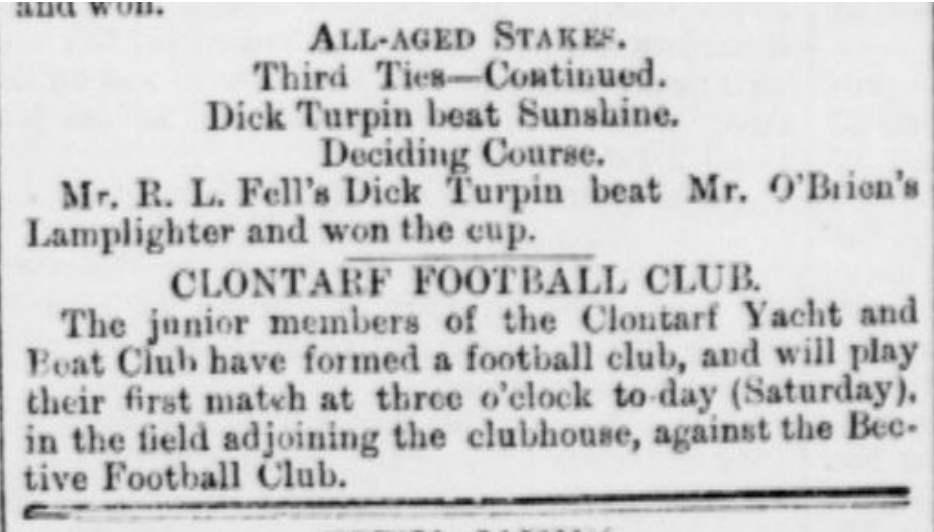
Clontarf Football Club is 150 years old today. On Saturday, 18th November 1876, the Morning Mail newspaper carried a notice announcing the first match of the newly formed Football Club, to be played that afternoon “in the field adjoining the clubhouse”.
And so Clontarf Football Club was born. A century and a half later, we look back at that first match, the opponents who lined out against us, and the fields the Club called home before it settled at Castle Avenue.
The first recorded match
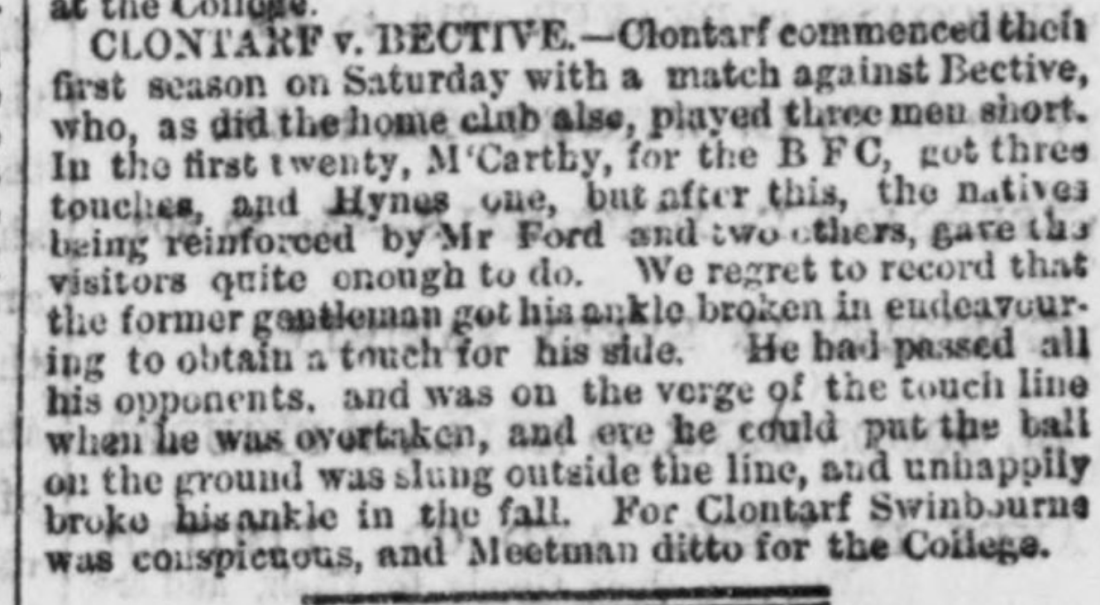
The Freeman’s Journal of the following Monday, 20th November 1876, carried a report of Clontarf’s first recorded match. It read as follows:
“Clontarf v. Bective. – Clontarf commenced their first season on Saturday with a match against Bective, who, as did the home club also, played three men short.
In the first twenty, McCarthy, for BFC, got three touches and Hynes one, but after this, the natives being reinforced by Mr. Ford and two others, gave the visitors quite enough to do. We regret to record that the former gentleman got his ankle broken in endeavouring to obtain a touch for his side. He had passed all his opponents, and was on the verge of the touchline when he was overtaken, and ere he could put the ball on the ground was slung outside the line, and unhappily broke his ankle in the fall.
For Clontarf Swinbourne, was conspicuous, and Meetman ditto for the College.”
Our first opponents
Bective Football Club was a rugby club within Bective House College. Founded in 1834 by Dr. John Lardner Burke, a Trinity College scholar, the College was advertised as a “Seminary for Young Gentlemen”. It operated initially at No. 15 Rutland Square (now Parnell Square East) and then North Great George’s Street, before permanently relocating to Clontarf and eventually closing in the 1880s.
The College’s most enduring legacy from that decade is its deep connection to Irish rugby. In the 1870s, past pupils of the Clontarf school banded together to form a rugby team. They initially played under the name “Bective College” before evolving into Bective Rangers FC, officially founded in 1881 and one of Ireland’s oldest and most renowned rugby clubs.
The rest of the first season
The newly formed club’s next recorded match was reported in Bell’s Life in London and Sporting Chronicle on 9th December 1876: a game against High School FC at the Clontarf Boat Club ground.
Further fixtures reported that season were:
- Kingsbridge, on Saturday, 16th December 1876
- The 93rd Highlanders, in January 1877
- Blackrock FC, on Saturday, 10th February 1877
- Survey FC, reported in The Freeman’s Journal on 9th March 1877
- The 93rd Highlanders again, on St Patrick’s Day, Saturday, 17th March 1877
The first pitch
As the Morning Mail notice tells us, that first game was played “in the field adjoining the clubhouse”. The clubhouse was Belvedere (or Belvidere) House, then and now the home of Clontarf Yacht & Boat Club.
An examination of local maps of the period, combined with the fact that the Clontarf Tram Sheds (now the Bus Depot) were under construction in the 1870s, suggests that the most likely location was the adjoining ground to the north-west: the land subsequently developed as Clontarf Park.
The accounts for 1876 record that three pounds was paid for rent of the pitch, with another six shillings and sixpence paid for goal posts. There is no indication of who the ground was rented from. However, anecdotal and written reports from members in the early 1900s mention Monsieur George, a French horse dealer who lived in Beachfield House (off the present Oulton Road), as having rented a pitch to the Club for three pounds.
Mr Walker and the cinders
By 1886, by which time the Club had been fielding a second team since 1878, rent for what appears to be the same pitch was being paid to a Mr Walker. In September 1887 the Club paid £7 for “Walker’s Field” for the season running from October 1887 to April 1888.
The relationship was fraught. The 1887 field committee minutes referred to “the perverse nature of that gentleman”. Tensions escalated in February 1889, when the Club discovered that Mr Walker had top-dressed the pitch by spreading cinders on it. The Honorary Treasurer was instructed to write demanding that the cinders be removed immediately, with the committee threatening to withhold the remaining 30 shillings of his rent if he refused.
Sharing the posts
Rugby was played on the ground on Saturdays only. On 18th October 1887, Mr Warren reported to the committee that a Mr Clinton had suggested that, if the Club would leave the goal posts standing on Sundays “for use of the Gaelic pastime players of Clontarf”, he would be responsible for their safety and would also house them during the summer months. The offer was accepted.
Vernon Avenue: a loft, a tub and a Refreshment Saloon
By October 1889 the committee was actively searching for a new field. In October 1892 they secured one off Vernon Avenue, owned by Mr William Murray, for £3 and 10 shillings for the season. A month later an extra 10 shillings was agreed so that the Club could also use the field on Thursdays. Mr Murray lived in Rossborough Terrace, near Church Gate Avenue, on Vernon Avenue.
The move cost the Club the use of the Yacht and Boat Club facilities. However, a committee member, Mr Stephens, a farmer who lived opposite the new pitch, allowed players to change in a loft on his farm.
At a committee meeting on 29th November 1892, some weeks after the move, the question of “washing facilities” for visitors was raised:
“It was proposed that tin basins should be purchased. This, however, fell through with Mr Stephens saying that “there was no way of getting rid of the soiled water except by throwing it about the place and that this would cause a great inconvenience and injure the dressing room.
Therefore, the committee decided not to get any basins, but to utilise a large tub in the garden opposite, which Mr Stephens said was at our disposal”.
With washing taken care of, Mr J Crawford said that “he did not approve of the manner in which the refreshments were given to the visitors and he thought that some better arrangement could be arrived at”.
Mr Stephens came to the rescue again, saying that “if he was supplied with some lumber, he would erect some kind of a Refreshment Saloon”. It was then decided that Mr Byron would be asked “to furnish more glasses and corkscrews with the refreshments in future”.
Castle Avenue
The most significant move in the Club’s early history came in the autumn of 1896, when Clontarf FC moved to Castle Avenue.
That year, Clontarf Cricket Club leased a new ground in Castle Avenue from the Vernon Estate, having left the ground it had been renting on the Howth Road. During the summer the Football Club approached the Cricket Club about sub-letting the new ground for the rugby season, and after a short period of discussion a deal was struck.
A letter received on 15th October 1896 from Mr N. Spence Black, acting Honorary Secretary of Clontarf Cricket Club, stated that “at a general meeting of Clontarf Cricket Club it was decided to accept the terms offered by Clontarf Football Club viz. £10 rent for the season ending the 31st of March 1897”.
The agreement marked the beginning of a formal association between the rugby and cricket clubs and established Castle Avenue as the long-term home of Clontarf rugby. For the first 50 years of the arrangement both clubs used the very same patch of grass (now the rugby pitches), with the cricket wicket fenced off during the winter rugby season.
Now 130 years old, this association is the longest “mixed sporting clubs marriage” in the country.
Lemonade for votes
Although the formal association dates from 1896, the two clubs had been sharing facilities well before then. In a memoir, Mr William Crawford, Club Honorary Secretary in 1895, reminisced as follows:
“Our stay at the Howth Road Cricket Club ground caused excitement at the start of each football season. Necessarily, football had to be played over the cricket pitches and this was strongly objected to by those who played cricket first. A general meeting of the Cricket Club was held at the North Star Hotel in, I think, September to decide whether the ground would be let to the football club; in other words the football club could not be certain of having any ground until the season started. The voting was very close and but for the redoubtable Jim Crawford, it would have gone cricket wise. Jim’s method was to prepare a list of the junior cricketers and to collect as many one shillings as he possibly could from the footballers. The money was spent on lemonade for the youngsters as a bribe for their votes. They kept the faith and the football club always secured the ground.”
From a rented field beside the Boat Club to Castle Avenue, the Club’s first twenty years were spent in search of a home. One hundred and fifty years on from that first Saturday against Bective, Clontarf Football Club is still playing.

Brendan Smith
Club President 2026/27